What to name your company?
Every business owner faces this question at some point early on in their journey. For some, it’s an easy decision. But for others, it can present quite a conundrum. Do you use your own name? Do you incorporate some reference to your industry? Or do you throw caution to the wind and make up a brand-new word?
The truth is, there isn’t an easy answer to this, or a one-size-fits-all solution.
But at Brannans, we’ve helped over a hundred entrepreneurs name their business and secure the matching domain, too.
So, as well as being experts in domain acquisitions, we’re now also quite the experts in naming companies!
Although there’s no right or wrong answer to what to name your company, here are a few tips to consider:
1. It’s always going to be cheaper to buy the domain name you want now. Quality domain names, like real estate, appreciate in value. When Frederick Law Olmsted was going around convincing cities, counties, and states to purchase property for parks, he always told the city planners that there’s never a better time to buy real estate than right now. Because, in a few years, the same real estate you’re considering will be more expensive to purchase. And this is especially the case nowadays with inflation sending the price of everything upwards! My point? Don’t hold off on choosing a company name because the domain attached with it comes with a hefty price tag. Swallow the cost upfront, and your business will thank you in the long run.
2. Choose quality and think ahead. Your company name must be something that stands the test of time (if you plan on your business having any longevity, that is). So, avoid choosing a name that plays too much into current trends or features any ‘words of the moment’ that might fall out of popular use in the next few years. The evolution of social media means words are constantly being added and removed from daily vocabulary depending on what the younger generation latch onto. If you plan on passing the business down through generations or eventually selling it one day, then don’t name it after yourself, either. Family name or initials may work, but I’d advise against having your first name or full name as the main point of focus.
3. Consider the competition and hurdles ahead. This is true even for a company that’s raised a substantial amount of cash and seemingly has ‘no budget.’ But there are some names that simply don’t make sense, even if you can afford to secure their domain. For instance, it would be foolish to choose a name like, “The Apple Company,” when consumers minds’ are too used to associating this name with iPhones, MacBooks and so on. We once had a client insist that they were going to own Baby.com (a developed website owned by Johnson and Johnson). So, we kept asking, offering and trying to purchase the domain name for them. When the cease-and-desist letter arrived from their general counsel’s office, we stopped asking, and we convinced our clients to pick another name. Sometimes, a name just isn’t worth it if it means an uphill battle with a long-standing multinational conglomerate.
4. Enlist the services of an expert. If you’re on this path, it is worth considering utilizing the services of a broker to help you out. If you choose us, we’ll work with you to freestyle a list of 10, 20, 50, or even 100 names you’d consider for your brand (without considering what may or may not be available). Our role is to help you identify the names you’re going to be happy with, identify the owners/decision makers who hold the domains associated to those domains, negotiate on your behalf, narrow the list down to one finalist at a time and make sure you get your desired domain name at the price you want. By the end of the process, we’re confident you’ll have both a domain and company name you’re happy with!
A word of caution - if you’re thinking about doing this alone, without a broker... don’t! We recommend against it. If you don’t choose us, then choose someone with equally strong referrals and completed transactions. A qualified broker will save you time and money. They’ll earn every bit of their fee (well they should in principle, if they're worth it!).
So, if you’re looking to launch a brand or a new company, let us know.
We’ll be happy to help you do some brainstorming, throw it all out there, and then start narrowing down the list by seeing what’s for sale and at what prices. And we’ll get you a domain name for your new brand or business.
It’s a win-win situation!
Give us a call or send us a message today if you're interested in enlisting our help in the process of naming your new business.
It’s easy to confuse domain names with URLs and just assume they’re the same thing. After all, both appear in the same place (at the search bar on the top of your webpage) and serve as some marker of a website’s virtual address. But they’re actually two different things, as this short guide explains.
What is a URL?
The letters ‘URL’ stand for Uniform Resource Locator. In simpler terms, it’s the whole link that directs you to a webpage, image, video, database or document. For example, the URL for our homepage would be https://www.brannans.com/. As we can see, this link is broken down into several different components. We have the ‘https://’ which is called the protocol, the subdomain (www) and finally, the domain.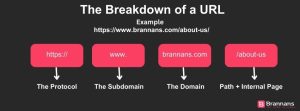
What is a Domain?
A domain is therefore part of what forms a URL. It usually refers to the ‘name’ of the website followed by an extension like .com, .org, .gov, .co.uk – and so on. So, “Brannans.com” would be our website’s domain. Think of it like digital real estate - it’s a home for your business on the Internet. The best locations (and by default the best domains) are usually very valuable and already taken. But, just like real estate, assets go on sale every day. At Brannans, our team of domain experts can work with you to help you acquire the domain of your dreams or sell an existing domain. The domain is easily the most valuable part of the URL, with many of the ultra-premium domain names we specialize in selling for upwards of six or seven figures.Main Differences Between Domains and URLs
→ Specificity – One thing worth mentioning is that URLs only direct you to a specific webpage or file on the Internet. In comparison, a domain refers to the whole collection of pages tied to a particular website. If we want someone to visit our website, we’d tell them to go to Brannans.com. But if they want to find something specific, like the domains we have for sale currently, then we can redirect them to the URL that links back to this specific page. → Value – Usually when we talk about the buying and selling of domain names, we mean just that – only the main word (or group of words) and the .com (or other extension) that follows it. This is the most distinct and recognizable part of the URL, and what your eyes naturally gravitate to at the top of the search bar. → Variability – One of the most fun parts of domain names is that they can be, quite literally, anything! A business name, a family name, a location, a portmanteau or something entirely made up – it’s up to you. We focus exclusively on buying and selling ultra-premium domain names. These are usually one-word, .com domains that hold immense power for branding and identity for a business, such as Ice.com or Batteries.com. In contrast, the protocol and subdomains of URLs are usually fixed or invariable. That’s why every website begins with “http” or “https” followed by “www.” → SEO – Although both the domain and URL have an impact on your website’s URL, the domain portion of the URL holds significantly more weight in how search engines index and treat your website. Google’s sophisticated algorithms are capable of honing in on a domain and seeing if it’s a good match for a user’s search query, so it’s always a good idea to have a domain that matches up to what you want your website to be known for. Overall, domains are just one part of the URL, but the part where all of the value and most of the action is held. If you have a domain you want to buy or sell, reach out to us today – nobody will work harder for you than us to secure the best outcome in your domain transaction.The premium domain market continues to show impressive growth in 2018. And we are very honored that more and more business are trusting us to find their perfect, brandable domain name or help them maximize the value of their digital assets. It’s rare that a premium .COM domain in the multi-billion-dollar education sector comes available. That's why we're excited and proud to announce that we have entered into an exclusive agreement to make the “Dissertations.com” premium domain available for confidential private sale. We know that this is going to be a great opportunity for an online university, research publication, secondary education services business, or other business to add brand and search value that will quickly grow their business. Dissertations.com was purchased by the original owner in 1997 to support their established business. Being one of the first to market and having such a premium domain established them as a market leader. Their website has been content-driven from day one, so there is a substantial amount of established search value built into this valuable .COM domain. Now that the business owner is ready to retire, all that brand and search value is ready to go to its next home. It's a real American success story. You can read more details in the press release.
