The Value of Single-Word Domains
As domain experts, we strongly understand the value that single-word domains hold. In fact, this is perfectly illustrated by the story of ICE.com – before the sale, this domain served as the URL for a successful eCommerce jewelry business. Yet the value of the domain alone grew to exceed the value of the business itself! This is a strong testament to how lucrative ultra-premium domain names can be (if you want to see what makes a domain ultra-premium check out this post). These domains are not just a strong investment in their own right, but also serve as a powerful branding asset for any business, whether a start-up or Fortune 500.The Perfect Sale? Everyone Wins
Our buyer recognized the value of ICE.com but relied on us as the domain experts to negotiate the best possible price for its purchase. When we are working on the buy-side to help a business acquire an ultra-premium domain name like this, we know that we are helping them succeed. This kind of purchase is more than just buying office furniture or sourcing commodities. It’s an investment in their future, and a surefire way to secure the right branding and marketing platform for their business. As a result, for less than the cost of a single, 30-second Super Bowl ad, we were able to help our client acquire this valuable, single-word domain name with significant long-term potential. And that is exactly what the perfect sale is – one where everyone wins: → Buyers are able to secure an asset at the best price, while recognizing its value. → Sellers are able to reap a return on their investment and sell at a profit. The ICE.com transaction really was a perfect example of this because everyone maximized their potential benefit and improved their positions. Our client – who has asked to remain anonymous for now – obtained a .com domain name that is short, one-word, memorable and uniquely generic and brandable. On the sell-side, a business that thrives on serial entrepreneurship fully capitalized a digital asset valuation under current market conditions with plans to reinvest those funds in new businesses and growth. We also had the pleasure to work with fellow domain name expert Brian Harbin of Grit Brokerage and Jackson Elsegood of Escrow.com on this transaction – two long-term industry professionals who are trustworthy and great to do business with. We look forward to working with both again. See… everyone wins! Further reporting on this story:- The story has been picked up by MarketWatch
- You can read all the details in the official press release here.
- We always love to read the solid Domain Name industry reporting at DNJournal, who also covered the story.
- And a special tip-of-the-hat to Konstantinos Zournas, who covered it as well, along with many others in the domain name industry media.
What is a brand?
A lot of people – even those in branding – struggle with answering this question:
How do I choose the best name for my company or brand?
The real question everyone should start with is really this one:
How do I choose the best domain name for my company or brand?
Domain names, in this day and age, are the same as your company or brand. They go on the books as indefinite-lived intangible assets. They represent a very specialized form of intellectual property. Picking and purchasing the right domain name for your company or brand can literally make or break your business. So, who should you turn to when it comes time to pick your company name and domain name?
The same intellectual property attorneys that you turn to for trademark advice and registration generally seek advice and the services of a trusted domain name broker like Brannans.com for the acquisition (or sale) of generic trophy domain names that will make the best brands – either as company names or as new products launched by those companies.
So, if you have this question, “how do I pick the best domain name and brand for my company,” you’ve come to the right place. Mute your phone, close the laptop, shut the door, and take some time to consider branding from the beginning to the 21st century.
Livestock branding has been going on for at least 4,700 years, and likely longer. An ancient Egyptian tomb painting depicting a cattle roundup and branding from 2700 BC is the earliest record of livestock branding.
In business, the term "brand" started getting used in the late 1880s when packaged goods like Coca-Cola started taking off. The Coca-Cola brand was used to differentiate similar products made by other companies. As branding progressed, marketers realized there was more to the brand of Coca-Cola than just a non-generic name. David Ogilvy, the “Father of Advertising,” defined the brand as “the intangible sum of a product’s attributes. “The Dictionary of a brand defines it as “a person’s perception of a product, service, experience, or organization.
Marty Neumeier, author and speaker on all things brand, defines the brand by first laying out what a brand is not: “A brand is not a logo. A brand is not an identity. A brand is not a product.” Neumeier goes on to say that “a brand is a person’s gut feeling about a product, service, or organization” when they hear or read your brand name. As branding has evolved, brands have become more subjective – more about perception and accumulated meaning.
Put simply, your “brand” is what your customer thinks of when he or she hears your brand or domain name. It’s everything they think they know about your company — both factual (e.g. It comes in a robin’s-egg-blue box), and emotional (e.g. It’s romantic). Your brand name exists objectively; people can see it. It’s fixed. But your brand exists only in someone’s mind. In fact, one of the ways we sometimes see that a brand is growing stronger is when its customers start referring to it by something different from its brand name. Think “Career.com” for graduate students looking for careers or “Bulldogs.com” for sports fans all over the globe rooting for their favorite football or rugby team.
So, why is defining what a brand is so difficult? What insights can we gather from this difficulty?
Brands mean different things to different people at different times. A single brand means something unique to each person – be it a current consumer, potential consumer, employee, recruit, or just within the world at large. Brands are dynamic. They can play a different role depending on who they interact with and when. Some people connect with certain aspects of a brand, while others connect meaningfully with another. And often times, a person’s relationship with a brand can really develop – increasing trust, loyalty, meaning, and engagement. Smart and successful brands work on reaching all the different audiences who matter to their business and aim to further their brand relationships with each individual.
At Brannans.com, our mission is to help you get the perfect domain name to deliver your values and promises to new and returning website visitors every day. Our goal is to help you get the perfect domain name.
The concept of brand has become so complicated, so varied, and so hard to pin down that a single definition really doesn't do it justice. The first thing we suggest to a new client, for many reasons, is that the words they consider must be easy to say and spell. A brand like Baby.com, owned by Johnson & Johnson, comes to mind. Some brands include the category-defining term that the company does business in - Flowers.com, Cars.com, or Batteries.com
Beginning in the later part of the 20th century, marketers began to grasp there was more to the perception of distinctive products and services than their names — something David Ogilvy described as “the intangible sum of a product’s attributes.” Marketers realized that they could create a specific perception in customers’ minds concerning the qualities and attributes of each non-generic product or service.
Brannans.com Mission: To help you get the perfect domain name to deliver your values and promises to new and returning visitors every day.
At Brannans.com, we help companies get the perfect domain name for their brand even if that domain name isn’t for sale. Brands are about feelings, and feelings are complicated. So, when you ask people why they love certain brands, it’s often hard for them to put into words. They might provide a list of rational and logical reasons, but in the end, it often comes down to a feeling. How does that brand really make them feel? And why do they come back for more of that feeling? Why does that feeling mean something to them? Successful brands today are always emotionally infused. They hold great emotional meaning for people and that’s what makes that brand loved and respected.
Highly recognizable, well-known brands are often used to define what a brand is.
More often than not, the question of defining what a brand is answered with a list of popular, well-known, established brands. Think CNN – Money.com, Barnes & Noble – Books.com, 1-800-flowers – Flowers.com, etc. Although these examples can reveal a lot about what a brand is, just thinking of the definition in terms of these big names isn’t enough. Consider all types of brands – big and small, global and local, new and old. Maybe even consider what businesses lack a brand and what makes them different from businesses that have built a brand they rely on. There’s a lot to learn from all the brands we interact with every day. Each brand is meaningful because of something different, and this is often what differentiates a brand and makes it powerful to the people who matter to it.
Defining the impact a brand can have is often easier than defining what a brand is. When we talk about naming a company, getting the domain name, and defining what your brand is, there isn’t a one-size-fits-all solution, but we do think a few points we address will help you out if you’re in this position.
Naming your company and domain is tricky, click here for more information on how to do it.
A service brand develops as companies move from manufacturing products to delivering complete solutions and intangible services. Service brands are characterized by the need to maintain a consistently high level of service delivery. This category includes the following:
- Classic service brands (Delta Airlines, Wells Fargo)
- Pure service providers (American Cancer Society | ACS)
- Professional service brands (J.P Morgan)
- Agents (Expedia, Hotwire, Trivago)
- Retail brands (Publix, Kroger, Nike, Adidas)
Organization brands are companies and other entities that deliver products and services. Mercedes and the U.S. Senate each possess strong organization brands, and each has associated qualities that make up their brand. Organizations can also be linked closely with the brand of an individual. For example, the U.S. Democratic Party is closely linked with Bill and Hillary Clinton and Barack Obama. A person can be considered a brand. It can be comprised of one individual, as in the cases of Oprah Winfrey or Mick Jagger. Or it may be composed of a few individuals, where the branding is associated with different personalities. With the advent of the Internet and social media, the phenomenon of personal branding offers tools and techniques for virtually anyone to create a brand around themselves.
Group branding happens when there is a small group of branded entities that have overlapping, interconnected brand equity. For example, the OWN group brand of the Oprah Winfrey Network and the brand of its known members (Oprah and her team) are strongly connected. Similarly, the Rolling Stones represents a group brand that is strongly associated with the personal brands of its members (most enduringly, Mick Jagger, Keith Richards, Ronnie Wood, and Charlie Watts).
Events can become brands when they strive to deliver a consistent experience that attracts consumer loyalty. Examples include conferences the TED series; music festivals like Coachella; sporting events like the Olympics or NASCAR; and touring Broadway musicals like Wicked. The strength of these brands depends on the experience of people attending the event. Savvy brand managers from product, service, and other types of brands realize the power of event brands and seek to have their brands associated with the event brands through sponsorships. Event sponsorship is now a thriving big business.
Many places or areas of the world seek to brand themselves to build awareness of the essential qualities they offer. Branded places can range from countries and states to cities, streets, and even buildings. Those who govern or represent these geographies work hard to develop the brand. Geographic branding is used frequently to attract commerce and economic investment, tourism, new residents, and so on. Private-label brands also called own brands, or store brands, exist among retailers that possess a particularly strong identity (such as Save-A-Lot). Private labels may denote superior, “select” quality, or lower cost for a quality product.
Media brands include newspapers, magazines, and television channels such as CNN. E-brands exist only in the virtual world. Many e-brands, such as Amazon.com, have a central focus on providing an online front end for delivering physical products or services. Others provide information and intangible services to benefit consumers. Typically, a common denominator among e-brands is the focus on delivering a valued service or experience in the virtual environment.
One of the five drivers of customer brand insistence is “value.” While value is comprised of more than just price (benefit bundle, perceived quality, etc.), it’s important to understand pricing to deliver strong brand value. The following are some concepts that you may find useful as you determine price for your brand’s products and services.
People often compare a brand’s price to a “reference price” that they maintain in their minds for the brand in question. A “reference price” is the price that people expect or deem to be reasonable for a certain type of brand
In 1985, The Internet Assigned Numbers Authority (IANA) released six top-level domain names. These top-level domains (TLD) became known as domain name extensions and represent the highest level in the Domain Name System hierarchy. They include:
- .com: shorthand for commercial, .com was the first top-level domain in common use. While .com was initially created for use by commercial organizations, restrictions on this were not stringent. By the mid-1990’s, .com had become the most popular and commonly used type of top-level domain for businesses, websites, and email.
- .net: shorthand for network, .net was created expressly for institutes that partook in network technologies such as an internet service provider or an infrastructure company. Like with .com, the restrictions meant to limit .net to networking purposes, was never upheld and it became one of the more popular top-level domains, with many seeing it as a close second to using the .com top level domain.
- .edu: shorthand for education, .edu was made for education institutions. Although it was intended for universities everywhere, the TLD .edu became associated with only educational centers in America. Schools from other countries will use .edu in conjunction with their country-level domain, which we will discuss in the next section below.
- .org: shorthand for organization, .org was created for nonprofits. As we’ve seen with these other top-level domains, such intentions were often not upheld or enforced over time. These days, .ors is used as top-level domain by nonprofits, for-profit businesses, schools, and communities.
- .mil: shorthand for military, .mil was created expressly for U.S. military branches. Unlike the other different types of top-level domains, this restriction is still upheld. Now, it is quite common for .mil to use second and third-level domains in conjunction with the .mil TLD.
- .gov: shorthand for government, .gov, like .mil, was restricted for American federal governmental agencies and personnel use only. These days, .gov is used by governmental agencies, programs, cities, states, towns, counties, and native American tribes.
What if a premium domain name is not for sale?
Many, many other ccTLDs and TLDs have come since the introduction of the .com TLD in 1985. There has never been a use case in the US of a TLD that will be used more than the .com. Our fingers, if we’re in the US, naturally type in .com after whatever we’ve heard. We hear Meet.me, we type in meetme.com. Overstock famously spent millions trying to rebrand as O.co and they had to go back to Overstock.com because it was confusing their customers. No matter what anyone tells you, .com is the only TLD that really matters for the US market. If you have to pick alternates, consider .net, .co, or .io but keep in mind that up to 50% of your anticipated website traffic and emails may go to the company or individual that owns the .com.
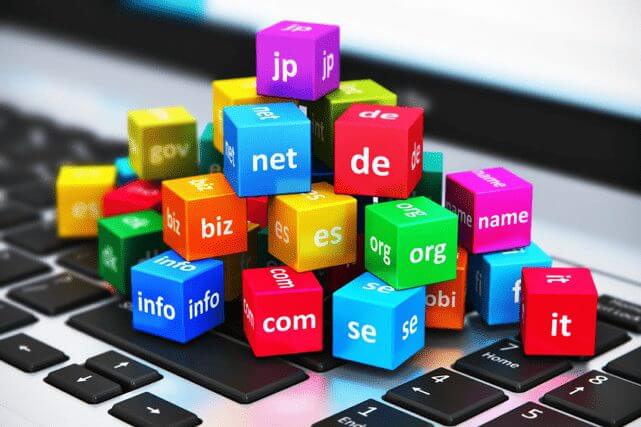
When considering domain names, you have trophy domains names which are stronger than ever in 2019. Earlier this year, the 5-letter, 1-syllable, 1-word .com domain name voice.com sold for $30,000,000. Just for the domain name. They’re also generic in nature. They generally represent category defining keywords (Batteries.com, Career.com, Doctors.com) but they could be animals (Bulldogs.com, Devils.com, Gophers.com) or something else that’s short and memorable (Meme.com, Dojo.com, Canes.com). The value of the initially secret November 2010 Facebook purchase of FB.com was revealed two months later to be $8.5 million in cash and the rest in stock. GMO Internet, Inc. purchased Z.com for nearly $6.8 million from Nissan, who previously used it for the Nissan Z series cars. As you can see, if you’re considering a purchase of a trophy domain name, it’s going to require a significant investment.
To look at premium domain names owned by major companies, click here.
Best domain name broker
When it comes to acquisitions of domain names, not for sale, we’ve represented many companies and helped them get the assets they want. You shouldn’t try to make a grab for a domain name of this caliber without retaining the services of a seasoned professional brokerage firm to represent your interests. We have worked with companies of all sizes to help them get the domain name they want. We regularly work with publicly traded companies. We also regularly work with startups ranging from those that are bootstrapped to those that have raised a Series E round.
When we are working on the buy-side to help a business acquire the perfect domain name that supports their brand, we know that we are helping them succeed. This kind of purchase is more than buying office furniture or sourcing commodities. It’s about helping them get the right branding and marketing platform for their business. The perfect, short, .COM domain can make a huge difference in helping a business grow – from start-up entrepreneurs to Fortune 500 enterprises.
When we are working on the sell-side, we are usually working with an existing entrepreneur or investor that acquired the domain a long time ago and used it to run their business or maintained it as an asset. Usually, they need to maximize their return to launch their next venture.
For information on Deal Quality and Deal Success click here to learn more about it.
Interested in a confidential, no-obligation discussion about your brand strategy and domain names? We'd love to hear from you. Contact Brannans.com now to set up a free 15 minute consultation.
The top 150 publicly discoverable domain name sales of all time are below. Each year, more transactions occur that are under strict NDAs but the trend is indisputable. Every year beats the previous year for top dollar domain name sales and we're seeing more US $ 8-figure domain name sales than ever before. Domain names are infrequently traded assets that share some of the same characteristics of other infrequently traded assets like real estate, antiques, or art. Inflation drives asset prices up. So does supply and demand. And demand has never been higher for premium, one-word .com domain names. Although domain names have only been around since January, 1985, their price changes have a show a clear attachment to the general economy. Economist and internet entrepreneur Thies Lindenthal used real estate economic methodology to provide investors with critical insight into the current market value of domains as a financial asset and in 2011 he had enough data to suggest that domains are as much an economic asset as real estate, stocks, or shares. By allowing comparison to other financial indicators such as the NASDAQ he was able to show that the trend lines for these indices follow the same path as the trend line for the domain market. Using a system he called the Hedonic Repeat Sales methodology (a combination of hedonic regression analysis and the repeat sales methodology) he was able to demonstrate this hypothesis using date from more than 200,000 domain sales.[1] In addition to factors mentioned above, Thies Lindenthal also wrote a paper providing empirical insights into the long-term nature of the loss aversion bias using a database of Amsterdam housing transactions spanning 324 years. The purchase price of the house is found to have been a psychological anchor, below which home owners were reluctant to sell their home. This result holds for 17th and 18th century Dutch home owners as well as for those who followed in their wake, but loss aversion appears to get stronger over the centuries. The anchoring power of the purchase price was strong: it survived the death of the original owner when the house passed on to the heirs.[2]Bottom Line:
There's never going to be a better time to buy a domain name or a stock than right now.
The prices are going to keep going up over time.
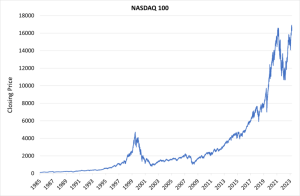
Nasdaq 100 Index Historical Chart (Source: Wikimedia)
| Premium Domain Name | Selling Price | Year |
| Cars.com* | $872,000,000 | 2015 |
| LasVegas.com | $90,000,000 | 2005 |
| CarInsurance.com | $49,700,000 | 2010 |
| Vegas.com | $38,000,000 | 2015 |
| Insurance.com | $35,600,000 | 2010 |
| VacationRentals.com | $35,000,000 | 2007 |
| PrivateJet.com | $30,200,000 | 2012 |
| Voice.com | $30,000,000 | 2019 |
| Batteries.com | $20,500,000 | 2007 |
| Bookings.com | $20,000,000 | 2012 |
| Internet.com | $18,000,000 | 2009 |
| 360.com | $17,000,000 | 2015 |
| Insure.com | $16,000,000 | 2009 |
| Chat.com | $15,500,000 | 2023 |
| NFTs.com | $15,000,000 | 2022 |
| Fab.com | $15,000,000 | 2014 |
| Bankaholic.com | $15,000,000 | 2008 |
| Rocket.com | $14,000,000 | 2024 |
| Sex.com | $14,000,000 | 2005 |
| Fund.com | $12,000,000 | 2008 |
| IRS.com | $12,500,000 | 2007 |
| Tesla.com | $11,000,000 | 2014 |
| AI.com | $11,000,000 | 2023 |
| Hotels.com | $11,000,000 | 2001 |
| CardRatings.com | $10,200,000 | 2008 |
| Connect.com | $10,000,000 | 2022 |
| Fund.com | $10,000,000 | 2008 |
| Porn.com | $9,500,000 | 2007 |
| Shoes.com | $9,000,000 | 2017 |
| Porno.com | $8,900,000 | 2015 |
| Gold.com | $8,515,000 | 2024 |
| FB.com | $8,500,000 | 2010 |
| RealEstate.com | $8,500,000 | 2011 |
| HealthInsurance.com | $8,130,000 | 2019 |
| WE.com | $8,000,000 | 2015 |
| Business.com | $7,500,000 | 1999 |
| Diamond.com | $7,500,000 | 2006 |
| Beer.com | $7,000,000 | 2004 |
| Z.com | $6,800,000 | 2014 |
| iCloud.com | $6,000,000 | 2011 |
| Israel.com | $5,900,000 | 2008 |
| Casino.com | $5,500,000 | 2003 |
| Slots.com | $5,500,000 | 2010 |
| Toys.com | $5,100,000 | 2009 |
| AsSeenOnTv.com | $5,100,000 | 2000 |
| Snap.com | $5,000,000 | 2016 |
| SEO.com | $5,000,000 | 2007 |
| Property.com | $5,000,000 | 2011 |
| Korea.com | $5,000,000 | 2000 |
| Clothes.com | $4,900,000 | 2008 |
| Medicare.com | $4,800,000 | 2014 |
| IG.com | $4,700,000 | 2013 |
| AV.com | $4,200,000 | 2021 |
| Marijuana.com | $4,200,000 | 2011 |
| GiftCard.com | $4,000,000 | 2012 |
| Freeporn | $4,000,000 | 2008 |
| YP.com | $3,900,000 | 2008 |
| IT.com | $3,800,000 | 2022 |
| HG.com | $3,800,000 | 2016 |
| MI.com | $3,600,000 | 2014 |
| Ice.com | $3,500,000 | 2018 |
| Shop.com | $3,500,000 | 2003 |
| Game.com | $3,400,000 | 2014 |
| Hippo.com | $3,300,000 | 2021 |
| AltaVista.com | $3,300,000 | 1998 |
| Wine.com | $3,300,000 | 2003 |
| Software.com | $3,200,000 | 2005 |
| Christmas.com | $3,125,000 | 2020 |
| Floor.com | $3,140,000 | 2021 |
| Whisky.com | $3,100,000 | 2013 |
| Help.com | $3,000,000 | 2023 |
| ASAP.com | $3,000,000 | 2021 |
| California.com | $3,000,000 | 2019 |
| Place.com | $3,000,000 | 2021 |
| Vodka.com | $3,000,000 | 2006 |
| Candy.com | $3,000,000 | 2009 |
| Loans.com | $3,000,000 | 2000 |
| Sex.xxx | $3,000,000 | 2014 |
| Wines.com | $2,900,000 | 2004 |
| Fly.com | $2,900,000 | 2017 |
| Shopping.de | $2,900,000 | 2009 |
| CreditCards.com | $2,800,000 | 2004 |
| KK.com | $2,700,000 | 2013 |
| Lotto.com | $2,680,000 | 2017 |
| Pizza.com | $2,600,000 | 2008 |
| Social.com | $2,600,000 | 2011 |
| Gambling.com | $2,500,000 | 2011 |
| Marketing.com | $2,500,000 | 2021 |
| GoTo.com | $2,500,000 | 2018 |
| Tom.com | $2,500,000 | 1999 |
| Investing.com | $2,500,000 | 2012 |
| Youxi.com | $2,430,000 | 2014 |
| KK.com | $2,400,000 | 2013 |
| Pharmacy.com | $2,300,000 | 2008 |
| Recruit.com | $2,226,000 | 2021 |
| Forge.com | $2,200,000 | 2021 |
| Autos.com | $2,200,000 | 1999 |
| Coupons.com | $2,200,000 | 2000 |
| Delta.com | $2,125,000 | 2000 |
| Computer.com | $2,100,000 | 2007 |
| 114.com | $2,100,000 | 2013 |
| Vivo.com | $2,100,000 | 2016 |
| Zoom.com | $2,000,000 | 2018 |
| AFS.com | $2,000,000 | 2021 |
| Angel.com | $2,000,000 | 2021 |
| NFT.com | $2,000,000 | 2021 |
| Wise.com | $2,000,000 | 2020 |
| Chatter.com | $2,000,000 | 2010 |
| ETH.com | $2,000,000 | 2017 |
| Express.com | $2,000,000 | 2000 |
| Telephone.com | $2,000,000 | 2000 |
| England.com | $2,000,000 | 1999 |
| Freedom.com | $2,000,000 | 2017 |
| 37.com | $2,000,000 | 2014 |
| IS.com | $1,950,000 | 2021 |
| Exodus.com | $1,950,000 | 2021 |
| Savings.com | $1,900,000 | 2003 |
| 01.com | $1,820,000 | 2017 |
| Better.com | $1,820,000 | 2015 |
| Mortgage.com | $1,800,000 | 2000 |
| Galaxy.com | $1,800,000 | 2021 |
| Seniors.com | $1,800,000 | 2007 |
| Fly.com | $1,800,000 | 2009 |
| Dating.com | $1,800,000 | 2010 |
| 20.com | $1,800,000 | 2017 |
| Auction.com | $1,700,000 | 2009 |
| DataRecovery.com | $1,700,000 | 2008 |
| Liu.com | $1,600,000 | 2014 |
| Call.com | $1,600,000 | 2022 |
| Chill.com | $1,600,000 | 2022 |
| Branson.com | $1,600,000 | 2006 |
| Ticket.com | $1,500,000 | 2009 |
| MarketingToday.com | $1,500,000 | 2005 |
| Gems.com | $1,500,000 | 2022 |
| Enjoy.com | $1,500,000 | 2015 |
| Fly.com | $1,500,000 | 1999 |
| Eko.com | $1,500,000 | 2019 |
| Deposit.com | $1,500,000 | 2000 |
| Cameras.com | $1,500,000 | 2006 |
| Russia.com | $1,500,000 | 2009 |
| Tandberg.com | $1,500,000 | 2007 |
| VIP.com | $1,400,000 | 2003 |
| FF.com | $1,400,000 | 2017 |
| eBet.com | $1,400,000 | 2013 |
| Power.com | $1,300,000 | 2014 |
| Banks.com | $1,300,000 | 2006 |
| Men.com | $1,300,000 | 2000 |
| TM.com | $1,250,000 | 2019 |
| Jade.com | $1,250,000 | 2016 |
| Photo.com | $1,250,000 | 2010 |
| Vista.com | $1,250,000 | 2007 |
| Feedback.com | $1,230,000 | 2003 |
| MM.com | $1,200,000 | 2014 |
| LA.com | $1,200,000 | 2016 |
| Super.com | $1,200,000 | 2018 |
| Find.com | $1,200,000 | 2004 |
| Phone.com | $1,200,000 | 2003 |
| MyWorld.com | $1,200,000 | 2017 |
The premium domain market continues to show impressive growth in 2018. And we are very honored that more and more business are trusting us to find their perfect, brandable domain name or help them maximize the value of their digital assets. It’s rare that a premium .COM domain in the multi-billion-dollar education sector comes available. That's why we're excited and proud to announce that we have entered into an exclusive agreement to make the “Dissertations.com” premium domain available for confidential private sale. We know that this is going to be a great opportunity for an online university, research publication, secondary education services business, or other business to add brand and search value that will quickly grow their business. Dissertations.com was purchased by the original owner in 1997 to support their established business. Being one of the first to market and having such a premium domain established them as a market leader. Their website has been content-driven from day one, so there is a substantial amount of established search value built into this valuable .COM domain. Now that the business owner is ready to retire, all that brand and search value is ready to go to its next home. It's a real American success story. You can read more details in the press release.
